Featured

Bringing Coaching to Life

Schools Week reported from ResearchEd18 that Sam Sims (associate research fellow at FFT Education Datalab) described Instructional Coaching as “probably the best evidenced form of CPD known to mankind”.

Bringing coaching to life in schools

— edited version originally appeared in the TES in 2019 (or was it 2018?).

Bringing coaching to life in schools.

There are a lot of lessons in life that can be drawn from music and cooking. Two that I have always particularly enjoyed applying to a variety of situations in work and at home are these: firstly, in music, it is often the silence or the gaps in the music that are the most difficult elements to get right and those which have the greatest impact on the listener. The second is from cooking and it is that food should be handled as little as possible in any given situation – overworked dough contracts and will not rise properly, over-whisked egg whites will go watery and lose their shape and shine, pastry will suffer from being exposed to hot hands for too long. In schools it is easy to fall into this trap in any number of different areas. Recently reported evidence in the field of data use suggests that some schools are putting the same dough through the pasta machine again and again but are we losing sight of the ingredients, their individual qualities and how we expect the end product to turn out?

It is this question that I have been toying with in recent years as I have tried to develop and improve our school’s coaching model. The question really boiled down to this: Can we reduce the hierarchical nature of the quality assurance process by introducing peer support and coaching as the main way of improving T&L in a secondary school context? If we could improve the balance of accountability and trust, by handling things a bit less (and managing the pauses in notation with greater confidence) then I am convinced that we will enable growth and promote the development of all teachers. We could avoid the pitfalls of the QA pasta machine squeezing the goodness out of our best practitioners by giving them the opportunity to share their craft while they are still at the top of their game in the classroom. I want to be clear that there is a role for QA, we need to make sure things are where we want them, however it must be proportionate and effective, rather than a stifling and mindless approach which does more harm than good.

As a teacher and leader of MFL over the years I had taken part in and led triads of coaching and co-planning based loosely around the GROW model (Goals, Reality, Options, Way forward) and found real success in small pockets of willing participants and in faculty. As I moved into senior leadership, with responsibility for Teaching and Learning and CPD, the challenge became how to find a way of expanding this, in a practical way, to the whole school. When I got the job, our school was not one with open doors and sharing of best practice at its heart – it was not short on good practice but teachers retained a bunker mentality and insularity reigned supreme. This backdrop combined with the twin pressures of time, opportunity and the mystical reputation that this form of coaching has managed to garner, which can make some uncomfortable, meant that past rollouts had not met with widespread success at our school. Cue a T&L group which managed to convert a couple of sceptics, and resulted again in more successful triads and again further challenges in the face of time and external pressures. However – each and every episode put teachers in the driving seat and opened more doors in more classrooms. Shards of light breaking through the cracks that demonstrated this might be the direction to follow.

In October 2016 I went to visit Rodillian Academy Trust with Deputy Headteacher Andy Percival who had recently introduced coaches called Deputy Directors in Learning to his school. This idea chimed exactly with my desire to rebalance trust and accountability at our school. In addition, it offered extra T&L leadership possibilities. I spoke with the coaches, toured the school and learned an awful lot in that day and took away so much learning which I have subsequently (slowly) been able to manipulate into a contextually appropriate shape and implement at our school. In addition to this visit I have read widely on the subject and T&L in general. Of particular significance in shaping thoughts on the subject for me have been the following: David Didau’s “What if everything you knew about teaching was wrong”, Doug Lemov’s “Teach Like a Champion”, Bambrick Santoyo’s “Leverage Leadership” among others. The bright face of Twitter can, at times, provide a rich seam of edu-inspiration from generous teachers and leaders – the outward facing nature of social media being a force for good, where it does not stray into polarised non-debate and fact-bereft nonsense.

The process of implementation coincided with the creation of our new school – as we became part of the Trust. As a leadership team we each had a unique opportunity to rewrite policies and include new ideas. This was not going to be a “new logo on a display board” effort, but rather a root and branch re-working of the central levers of the school. In the area of T&L and CPD the coaching – and the Deputy Directors in Learning (DDLs) were going to form a central part of this plan. In the year 2016/2017 prior to launch in September 2017, a T&L focus group was formed to trial the various different “Teach Like a Champion” strategies that I hoped to include in the new policy, we trialled these in about 12 classrooms and teachers fed back. It would be the teachers who trialled these techniques that would end up interviewing for the DDL positions and they would have the language and the expertise already at their disposal to promote the style of T&L that would take our school forwards in September. It was at the end of this year, that a second unique opportunity presented itself via Swindon Challenge: a visit to a school in Accrington to do some Leverage Leadership training with Uncommon Schools.

The DDL coaching strategy has formed part of the vast breadth of changes that our school has undergone – and can rightly be included in the list of impactful changes that have led to improvements. We have now clarified some of the processes and more closely aligned with the Incremental or Instructional Coaching Model as defined by Bambrick-Santoyo in “Leverage Leadership” (and another of his books called “Get Better Faster”). Instructional Coaching is about isolating one element of teaching practice to improve in an action step, through discussion with the coachee, which might then be honed and practiced. It reduces the gap between feedback and action – all the while retaining the excellent focus on questioning. We are using the six steps for effective feedback and, in response to requests, have set aside two Monday meetings a (short) term in the calendar to set up and review the “plan, practice, follow up, review” cycle that will take place in between. Each new revision to the model is trialled with the DDLs to assess practicability and timings, it has been so important to ensure clarity throughout the process and to make sure what we are asking people to do is possible on a normal timetable. We have rolled this out to all staff .

In terms of challenges, the scale of change that we have effected during this period has been significant and we are lucky to have had the support of a talented and resilient staff base. Also extra capacity from the Trust supported in year one of our launch – which provided invaluable sounding boards for us and access to excellent OLEVI CPD opportunities in their teaching school for many of our staff. The majority of the changes introduced, including the DDL coaching have been about harnessing the existing talents within the school, making very effective systems that do what they say on the tin and also reduce the load on teachers. We stopped grading lessons in 2015, and gave our lesson observations a developmental focus linked to a teacher-selected target. We have begun the process of reducing our reliance on traditional QA, we are not throwing everything out with the bathwater but simply trying to handle things a bit less and feel confident with the silences. The pendulum of trust and accountability has swung and we might dare to envision a situation where the instructional coaching model we are developing eclipses the requirement for simple evaluation style observations and our teachers can work together to bring coaching to life in schools.
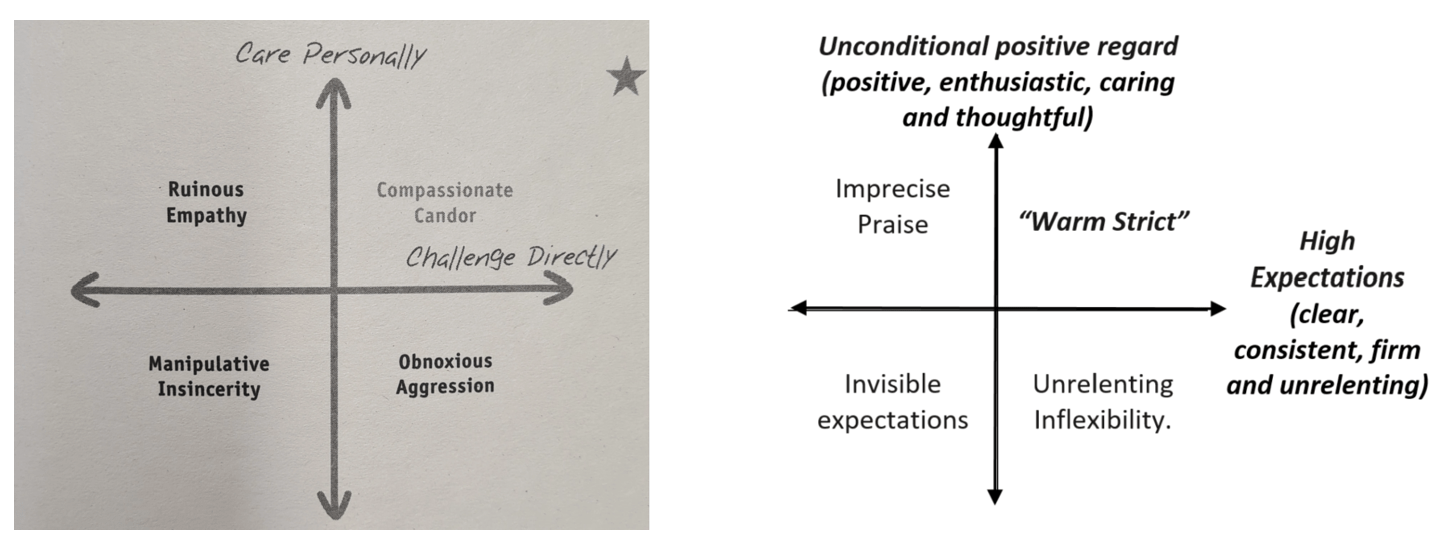
Radical Candour meets Warm Strict

Thomas Szasz, a Hungarian-American academic, psychiatrist and psychoanalyst, suggested that “Every act of conscious learning requires the willingness to suffer an injury to one’s self-esteem. That is why young children, before they are aware of their own self-importance, learn so easily; and why older persons, especially if vain or important, cannot learn at all.” While there is truth in what Szasz is saying – I wonder if we might ask ourselves if we are creating the right conditions for learning which might circumvent apparent feelings of “vanity” or “self-importance” that could easily be manifestations of fear or mistrust of our own unnamed, unintended behaviours as teachers and leaders.

Warm Strict, from Doug Lemov’s book Teach Like a Champion asserts that there are two sides to creating the right conditions for pupils to flourish in a classroom that must exist in the same instant. Firstly, being “warm” – connecting to children, showing that you care, building relationships (quote of the year so far from TLaC 3 – “Teaching well is relationship building”) while simultaneously delivering on high expectations with considered, consistent and deliberate culture/instruction/feedback/praise – the “strict” side.

Lemov uses words like relentless, warm, gracious, caring and quotes Zaretta Hammond from her book Culturally Responsive Teaching and the Brain who talks of “Warm Demanders” and “active demandingness”. Hammond describes the over-effusion of empathy from a teacher whose lack of strictness or willingness to reduce their expectations as being a “sentimentalist” who “allows students to engage in behaviours that are not in their self-interest”. Lemov is careful to acknowledge the emotional burden the accompanies the word “strict”. Moving our minds away from connotations of compliance and steering us to a mindset where we might “prepare the child for the road, not the road for the child”.

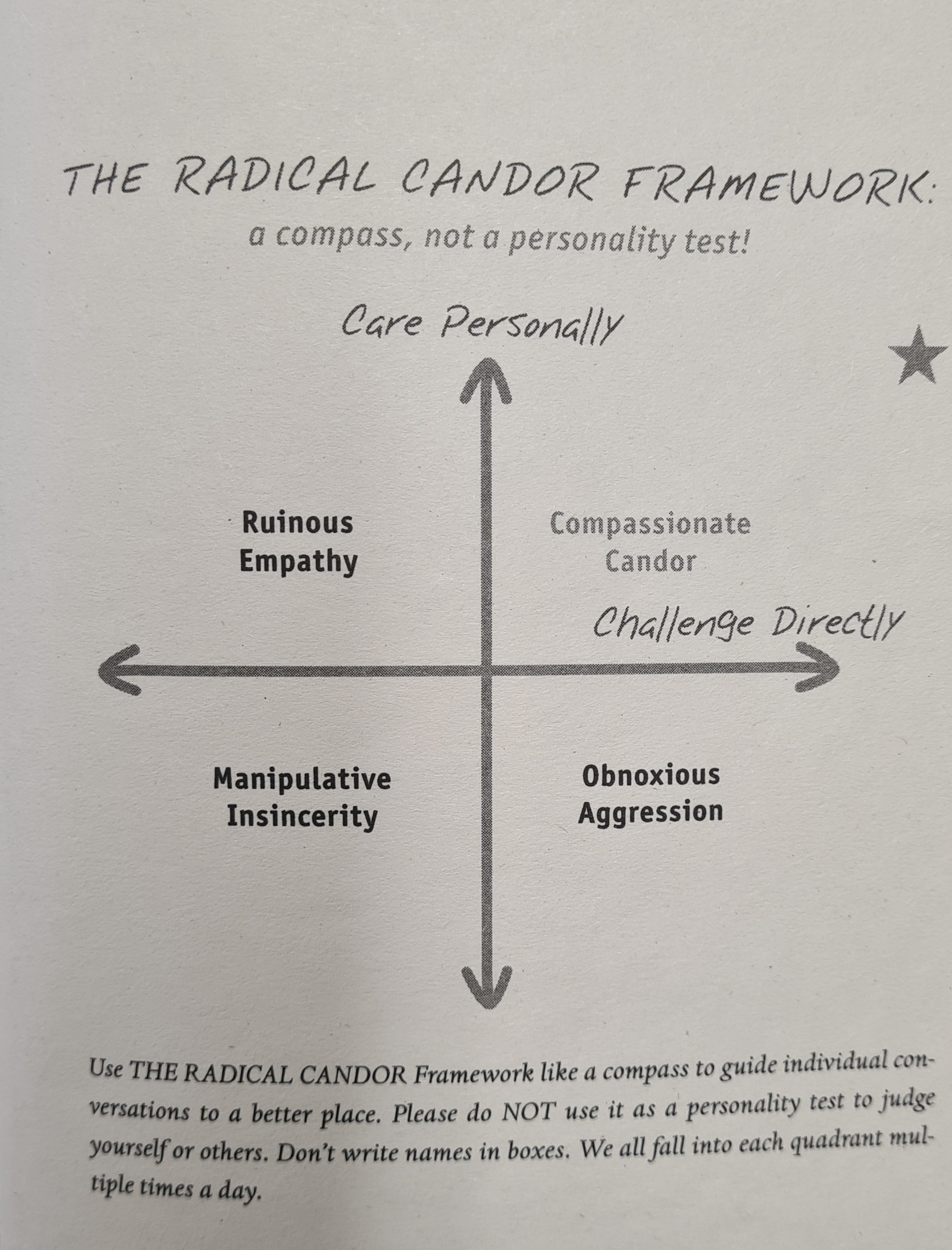
In the preface to the revised edition of Radical Candour (I will use the anglicised spelling) by Kim Scott, she offers the replacement title Compassionate Candour. Scott describes compassion as “empathy plus action”.  In short, the book is focused on a quadrant whose two axes are based on “Caring personally” and “challenging directly” in order to encourage the best from the people with whom you work. Scott has labelled the four quadrants with behaviours and describes in detail in the book how these behaviours manifest in interactions in the workplace (see above image from Radical Candor, 2019, Kim Scott). Radical candour or compassionate candour is the essential ingredient which represents “the virtuous cycle between your responsibilities and your relationships” enabling you to learn the best ways “to get, give and encourage guidance”.

We can draw parallels between Lemov’s Warm Strict and Compassionate Candour as defined by Kim Scott: in both cases, if the first essential element can be boiled down to sincere human consideration, the second: challenging directly and holding high expectations must represent the feedback offered to make this happen. We might see clear links in the pitfalls of ruinous empathy where a manager favours caring personally without applying any challenge resulting in low levels of development and the potential risk of underperformance in the same way that we have seen how the “sentimentalist” in the classroom chooses “the short-term benefits to herself of satisfying personal relationships over students’ long-term success”. 

In Radical Candour, Scott evaluates the quadrant through a number of prisms, including relationships, guidance, motivations and results. Each time, exploring how you might reflect on your own behaviours as you interact with your team – creating the conditions for your team or co-workers to thrive. Replacing Compassionate Candour with Warm Strict, we can look at the teacher pupil interactions through Kim Scott’s lens. We can begin to reflect on the effect that particular behaviours might have on the pupils in our classes and the resulting impact on our desired outcomes for that group of young people. Here I have attempted, somewhat clumsily, to recast Scott’s work focusing on teachers and pupils as opposed to adults managing one another.

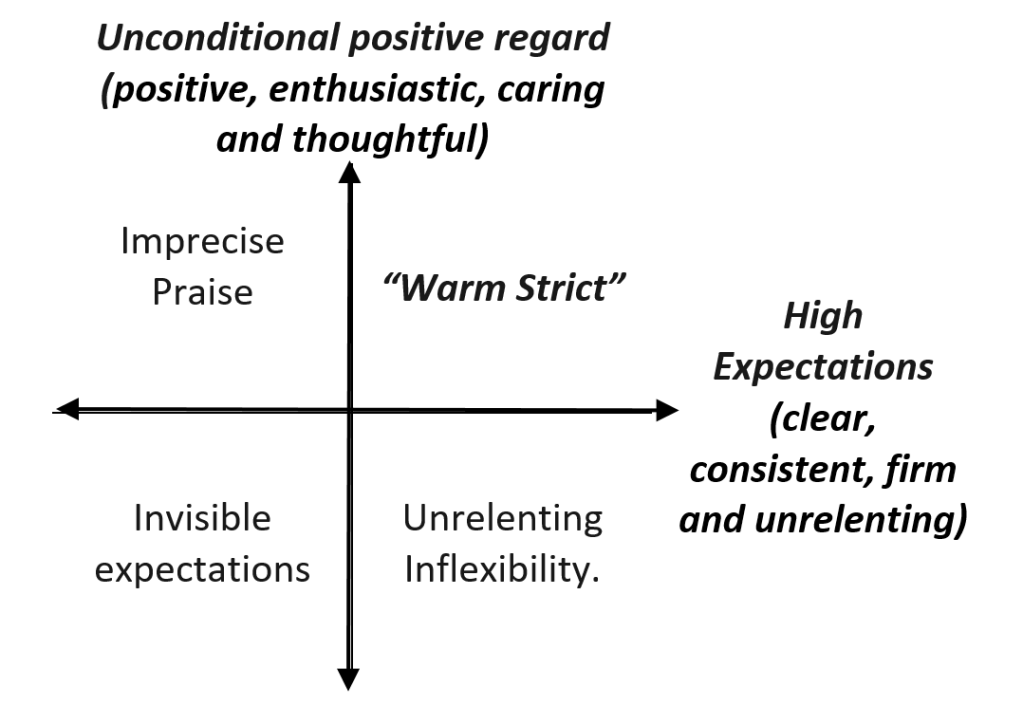
Warm Strict is the optimal quadrant, where unconditional positive regard meets high expectations. This will favour conditions for learning that might reduce mistrust and engender attentiveness and risk taking. I see this a lot in classrooms in our school. As with Kim Scott’s diagram, these are not personality types, but a compass of behaviours that we might drift in and out of during the course of a day under the various pressures that accompany working in a school. As in Scott’s book, the idea would be to focus on ways of working which enable you to occupy the optimal quadrant as often as possible in work place or classroom interactions.

Imprecise praise might illustrate a situation in class where praise relates to person/personality and not actions or gives effusive or meaningless affirmations that offer little in the way of deliberate guidance. This might lead to a young person feeling inaccurately defined, labelled or constrained. This could be intentional, meant as a way to build relationships and trust, or it could be unintentional: as a result of a lack of deliberate planning and thought. We might very well care deeply but if the actions we take to demonstrate this are not linked to clear expectations it means that potential learning and relationships are built on shifting sands.  

Invisible expectations might see us holding a pupil to account for something that is poorly or barely explained either in terms of behaviour or learning. This lack of transparency implicitly relates a lack of connection and creates unnecessary trap doors for pupils, and ultimately, for teachers. In the long term this will not only lead to poor relationships but learning is likely to be less effective as low or no expectations conspire with an absence of human consideration.

Unrelenting inflexibility tells a story, rich in expectations and clarity, but locked into the rigid stare of the long and unbending “my way” ahead. In this quadrant the paths to learning and behaviours are writ large on a single arrow. Learning might be strong but relationships will take time and may not flourish, some resulting barriers may lead to inattentiveness and rejection, leaving room to care more about the people that one might be keen to hold to account in a class.

In the title of Lemov’s technique number 60 Warm Strict and the tagline of Scott’s Radical Candour “how to get what you want by saying what you mean” a distracting curtain of assertiveness shrouds caring and thoughtful content and meaning. In order to ensure that your actions as pedagogue yield effective results, whether in training and developing adults in the work place or with educating pupils at school: remain fixed on achieving ascribed goals through high expectations and clear feedback. However, although the focus on development is keen, the message about personal investment is unambiguous. It is possible then, that by focusing on these similarities in human nature, that the old adage of balancing trust and accountability can find meaning here, within the pages of these books, across the generational divide.

Rosenshine vs TLaC (Lemov)

It is encouraging to see “Teach Like a Champion” being, er, championed around the Twittersphere, and wonderful to see people posting pages from the book and others cooing and cocking their head in curiosity and wonder – with an open mind. Why you would do anything else?

I have heard rumours that there are some people that call it “teaching by numbers”, or similar. Having read the book, I find it hard to make this work in my mind. I do have some sympathy with teachers who come across the ideas and say that it is nothing new. However, it does not pretend to be. After all, the book is billed by Lemov as a “Field-researched guide” to the best strategies and techniques that he has pulled together from master teachers whose impact on pupil outcomes is proven. Rosenshine garners similar criticism from certain corners (Tom Sherrington has written about this in detail. Link below).

What the book talks about is not doing something new, but doing something well. I hope Dylan Wiliam will forgive me for misquoting him as I recall he sensibly suggested “Let’s stop looking for the next big thing, and start doing the last big thing properly”.

A year or so ago, I shared a document which was named Rosenshine vs. TLaC. In it, I linked Rosenshine’s 10 Principles of instruction to some of the Strategies in Teach Like a Champion. It started out because I was keen for teachers at our school to look at TLaC through another lens – we have invested in the strategies and I wanted to find an efficient, visual way for teachers and coaches to identify and name action steps which would have a linked strategy. A discussion piece, to lift the petticoat on some undiscovered techniques which appear in the book. I suppose it was inspired by Tom Sherrington’s wide sharing of the research paper itself (pre-book), OliCav’s wonderful poster and the genius that is the Scope and Sequence from “Get Better Faster” (Bambrick-Santoyo).

I wanted to collate a few thoughts on the Rosenshine vs. TLaC poster and thought I could do it here – for clarity – we do not grade lessons in our school, have not done so for 5 years and our coaching system operates completely separately from QA – there is no link and no “reporting back” to SLT. Ever.

  1. Everyday is a new day

Every class everyday presents a new challenge. Experience can bestow expertise but does not denote it in every circumstance. The most reflective and honest practitioner in any field will always seek to fine tune skills and improve knowledge: building, developing and seeking out a “frustrating” catalogue of known unknowns to keep the job interesting and make them more effective at their chosen endeavour. It would be hard not to find something to reflect on in one of the 10 principles or the 62 techniques which would help as you look back on a lesson which left you feeling like something wasn’t quite in place. Don’t get me wrong – these research pieces do not encapsulate all that it is to be a teacher. As an excellent teacher once said to me, aged 12, when looking into the exception that proved the rule in a particularly challenging piece of grammar “Justin, every horse has four legs, but not everything with four legs is a horse”. I think about this a lot.

2. What no scaffolding? “What to Do” (TLaC 57) EX vs AC

With this in mind, I did run into some problems when carrying out this mapping exercise, it was necessary to make some small tweaks to one of the techniques, and having done this, a gap began to appear. In TLaC there are excellent techniques for creating the conditions for modelling, scaffolding and guided practice. There are excellent videos demonstrating how to incorporate positive framing and how not to “show your tell” when creating a “Culture of error”. All potentially yielding effective instructional environments. However, when you begin to cross reference with Bambrick-Santoyo’s techniques in “Leverage Leadership” for data driven instruction – where close analysis of data gathered in class (back to TLaC again with “Tracking not Watching”) informs a requirement for a re-teach or whole-class modelling of identified concepts or problems – then the detail begins to thin out. The answer I came up with was to modify “What to do”, a routine based technique for giving instructions about preparing for activities, and add EX for explanations and AC for incorporating scaffolding to enable all learners to reach the high levels of academic rigour/challenge planned for. I posed this question to Doug Lemov in London on a Reading Reconsidered Training course in December 2019. Lemov was typically magnanimous and considerate – not dismissing me out of hand or pointing to obvious areas of the book that I might have missed. Instead, indicating that he was not yet done and further publications were in the pipeline! Looking forward that.

In the meantime, to build knowledge and develop applications in this area we are fortunate to have people like Stephen Tierney (@leadinglearner on Twitter) who writes about scaffolding effects here:

3. Novice vs Expert

The real impact of this poster has been, unsurprisingly, among novice teachers who – now more than ever are being directed to get to the root of what makes people learn. It is not a case of what makes it nice to learn, or what will make people “happy” to absorb the perfect subjunctive / water cycle / Battle of Hastings – but how can I deliver this material so skilfully and be as certain as possible that it has been understood and retained? It is such an exciting time to be a teacher – so inspiring to have all of this incredible opportunity and expertise at our fingertips. Many expert teachers have been exploiting techniques to achieve learning in this way for years. Clearly and accurately naming the steps has, in my experience, been less widespread. Now, with the proliferation of, and wide exposure to, this type of research we can all find a way to talk about what works and how to improve it.

When coaching more experienced teachers, sometimes it is appropriate to use this document as a discussion point, for example with a particular class to improve the culture or when complex content means instructional efficacy falters. At other times the subtle nuances of pupil output may require a more tailored approach – analysis of in-class data gathering techniques, use of this data, lesson study type activities, assessment review through data driven instruction activities (again, care of Paul Bambrick-Santoyo).

4. Convergence vs a culture of “no”

It feels to me as if currently there is a convergence that goes beyond the language. The wide acknowledgement of the four simple pillars of culture, pedagogy, assessment and curriculum that has seeped out through the teacher standards for years is writ large across popular research-informed literature. The circle is visible and the ends are meeting. That tiny dose of “the practicable”, which you held out for in order to sweeten the bitter pill of nonsense which made up the majority of the terrible courses of yore, has grown in quantity and availability. We have, for example, the Early Career Framework – which is, quite frankly, galling to see arrive 20 years too late for me – new teachers of today rejoice!

Yet it is not everywhere – the culture of “no” persists. There are those who still think it is ok, literally, to make things up and share them. People who can profit from saying what is not: the wonderful British quirk of finding success and turning on it. The “Ofsted don’t want this” list is exactly the same as the recent and very damaging “Ofsted does want this” list that it purports to be rejecting. Caveat Emptor!

5. Science and Nurture

Much of the core of these developments is couched in the coalescence of cognitive science and teaching. What a joy to be able to clasp at the the coat tails of scientific surety, and to witness the same messages coming through loud and clear. Pragmatism and rigorous context specific choices are key. Panaceas are not on the lunchtime menu in education – nothing comes easily, or for “free”.

The desire that teachers all share, to develop the minds of young people into curious, capable, independent systems with which to operate the world around them will, with luck and determination, win out over the petty disagreements that persist – but not, I sincerely hope, at the expense of successful strategies which support the effective education of young people.

I cannot help thinking that a lot of the debate around the various merits of Teach Like a Champion et al might come from the difference between the function of a school and the function of teaching. While these things are interconnected they are at their heart different. Teaching, in essence, is about ensuring learning happens. Schools are about that too – but they have a greater stake in the child. Teachers are providing building blocks of knowledge in their subjects within the large edifice of learning that a school both literally and figuratively represents.

Design a site like this with WordPress.com
Get started